Buying guide
The composite door buying guide
Every decision you need to make, in the order you need to make it, with the trade offs stated rather than glossed over. Twenty minutes here will save you a lot of money and at least one regret.
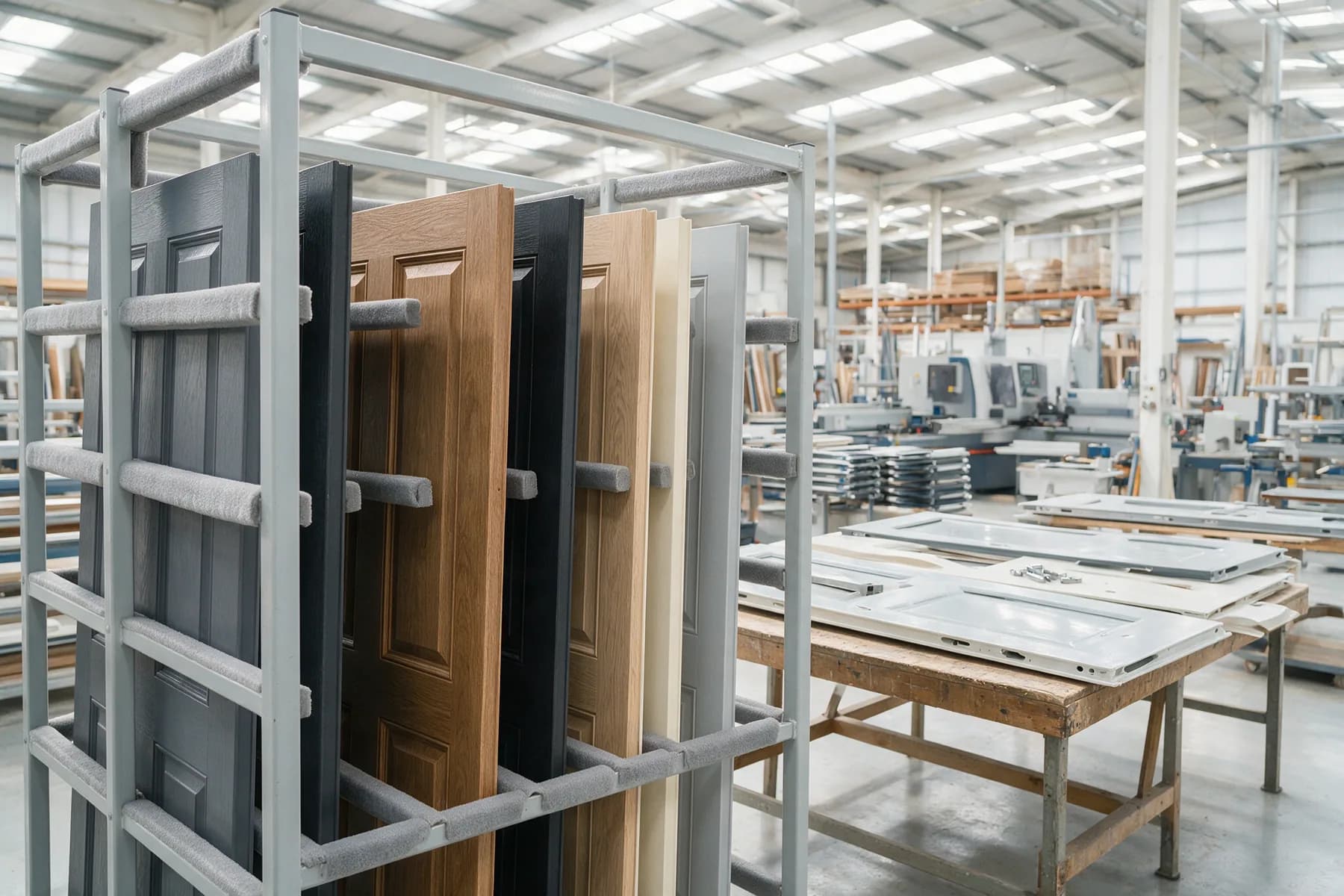
1. Decide what problem you are solving
Most people buy a door for one of four reasons: the old one is draughty, the old one is not secure, the old one looks tired, or they are extending and need a new opening filled. Being clear about which one you are solving tells you where to spend.
- Draughty: any composite door will transform this. Spend on the frame and the seals, not the glass.
- Insecure: spend on the cylinder. A 3 star anti-snap cylinder is the single highest value item on the whole order.
- Tired: spend on the core and the mouldings, because that is what you will look at.
- New opening: spend on getting the sizes right, and consider a door set with a sidelight rather than a door plus a separate window.
2. Choose the core
This is the decision that separates the ranges. Door-Stop use a high density insulating foam core. Solidor use 48mm of solid laminated timber. Both are wrapped in the same kind of GRP skin and both carry the same guarantee.
| Foam core (Door-Stop) | Solid timber core (Solidor) | |
|---|---|---|
| Weight and feel | Lighter | Noticeably heavier and stiffer |
| Moulding depth | Shallower pressing | Deep machined relief |
| Thermal performance | Excellent | Very good |
| Colour choice | 19 colours | 22 colours, different inside and out |
| Price | From £649 | From £949 |
| Best for | Back doors, rentals, value front doors | Front doors that matter |
3. Choose a style that fits the house
A door that argues with the elevation will bother you forever. Panelled designs suit anything pre 1960, cottage designs with small panes suit stone and render, and long vertical glazing suits modern properties and anything with grey aluminium windows.
The test that works: stand across the road and look at your house. If the windows have bars, the door probably wants some. If everything is plain and grey, the door should be too.
4. Decide how much glass you want
Glass buys you daylight and costs you privacy, and there is no way around that trade off other than obscuring the glass. Obscure and sandblasted patterns pass a surprising amount of light while making shapes unreadable, and they are available on every aperture.
- Front door onto a pavement: obscure or sandblasted, every time.
- Front door behind a porch or gate: clear is fine and you will get a lot more light.
- Period property: leaded, and keep the pattern simple.
- Dark hallway with no other window: go for the largest aperture the style allows.
5. Get the security right
The leaf is not the weak point. The cylinder is. Cylinder snapping takes seconds with the right tool and defeats an otherwise excellent door, and a TS007 3 star anti-snap cylinder removes the attack entirely for well under a hundred pounds.
If you take one thing from this guide, take that. It is also worth checking your home insurance schedule, because many policies have a condition about the locks on final exit doors.
6. Choose the colour, carefully
Anthracite grey is the default for good reason: it matches the grey windows on most of the country's housing stock. But it is very common, and if you want the door to be memorable there are twenty one other options.
Whatever you choose, do not decide from a screen alone. Ask for samples. A bespoke door in a colour you dislike cannot be returned.
7. Measure, then measure again
Brick to brick, three measurements across and three down, smallest of each. Account for any floor finish you are laying afterwards. Do not deduct a fitting tolerance yourself — the manufacturer does that.
8. Understand the lead time
Nothing is in stock. Every door is built to your sizes after you pay, which is exactly why it fits and exactly why it takes ten to fifteen working days. Anybody promising a bespoke composite door in 48 hours is selling you a standard size.
9. Know what you are paying for
A properly made British composite door set, supply only and delivered, sits between roughly £650 and £1,600 including VAT. Below about £550 you are almost certainly looking at an imported slab in a thin unreinforced frame with a basic cylinder.
Above about £1,800 for a single door with no sidelights, you are usually paying an installer's margin, which is entirely fair if they are fitting it but is not something you should pay for supply only.
10. Plan the fitting before the door arrives
- Book your fitter for a date after the lead time, not on it.
- Make sure somebody can receive and check the delivery.
- Have somewhere dry and out of the sun to store it.
- Do the floor finish first if you can, or account for it in the height.
- Check the opening is sound. A door will not fix a cracked lintel or a failing threshold.
Ready to price your door?
Build it exactly how you want it and see the number in about four minutes.